
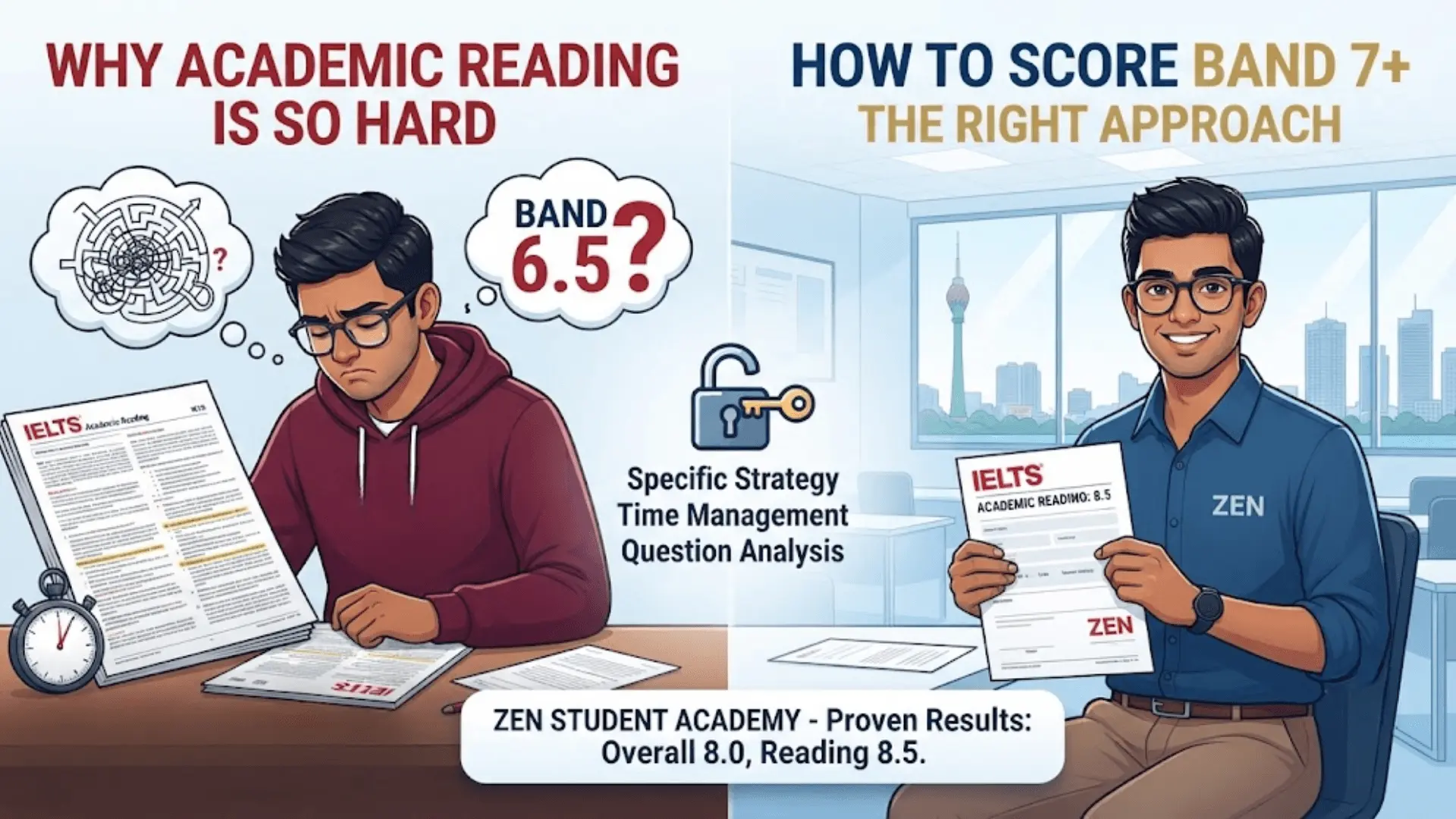
Academic Reading is the section that quietly wrecks the most Band 7+ dreams. Not Speaking. Not even Writing. Reading.
We’ve watched fluent English speakers right here in Sri Lanka, people who studied abroad, who work in English daily, walk out of the test confused about how they missed Band 7. Why does a section that “just” involves reading three passages trip up so many capable people?
At Zen Student Academy, we’ve coached students to strong results, including an Overall Band Score of 8.0, with an 8.5 in Reading. That’s not a fluke. It’s the outcome of a specific, repeatable approach to IELTS Academic Reading, and we want to walk you through exactly how it works.
Understanding IELTS Academic Reading
The format looks simple on paper: three passages, 40 questions, 60 minutes, no extra time to transfer answers. But the content is anything but simple.
Passages are pulled from academic journals, research summaries, and university-level texts. The subject matter ranges from marine biology to economic history, and you won’t get to choose your topics.
This is where the Academic version splits from General Training Reading. General Training uses everyday materials: notices, advertisements, workplace documents. This section uses dense, abstract writing built for an academic audience, not casual readers.
That difference matters for your time management, too. You’re not skimming a flyer. You’re decoding research-style sentences with multiple clauses, often on topics you’ve never studied, in roughly 20 minutes per passage.
Main Challenges of IELTS Academic Reading
Challenge #1 – Time Pressure
Sixty minutes. Three passages. Forty questions. That works out to about 20 minutes per passage, including the time it takes to actually answer the questions, not just read.
In our sessions, students almost always run out of time on Passage 3. By that point, fatigue has set in, the vocabulary gets harder, and the clock is unforgiving. Without a pacing plan, even strong readers panic and start guessing.
Challenge #2 – Unfamiliar Academic Vocabulary
These passages use vocabulary you won’t hear in daily conversation. Words tied to research methodology, scientific processes, or formal argument structure show up constantly.
We’ve had students who speak fluent conversational English misread an entire question because of a single unfamiliar word in a key sentence. One word can flip the meaning of a claim, and that’s exactly what the test is checking for.
Challenge #3 – Question Types That Trick Test-Takers
True/False/Not Given, Matching Headings, and Sentence Completion each come with their own traps.
The most common one we see? Confusing “Not Given” with “False.” Test-takers assume that if a passage doesn’t directly support a statement, it must be false. In reality, “Not Given” means the information simply isn’t there, and that distinction costs candidates marks constantly.
IELTS Academic Reading – Comparison & Best Practices
Here’s a quick breakdown of the question types that trip people up most, along with the strategy we actually drill with students:
| Question Type | Common Trap | Best Strategy | Suggested Time |
| True/False/Not Given | Confusing “Not Given” with “False” | Locate the keyword, check exact wording | 1 min/question |
| Matching Headings | Choosing based on the first sentence only | Skim the full paragraph for the main idea | 1.5 min/question |
| Sentence Completion | Grammar mismatch | Check word limit + grammatical fit | 1 min/question |
Mastering skimming and scanning techniques isn’t optional here, it’s the foundation everything else builds on. Working through practice tests with proper answer keys afterward is how that skill actually sharpens over time, rather than staying theoretical.
How This Section Impacts Students and Professionals
This isn’t just an academic exercise. A Band 7 in Reading specifically, not just overall, is a hard requirement for many university programs, particularly competitive ones in the UK, Australia, and Canada.
It also matters for skilled migration visas and professional registration boards, where Reading is assessed and scored on its own, separate from your overall band.
According to the official IELTS band score descriptors, a Band 7 reflects “good” English usage with occasional inaccuracies, someone who can handle complex language and detailed reasoning. A Band 8.5, the level we’ve seen our students reach, reflects “very good” command with only rare, non-systematic errors.
If you’re applying for a program or visa pathway with a specific Reading cutoff, that gap between Band 6.5 and Band 7 can mean the difference between an acceptance and a rejection, even if your other scores are strong.
Real Result: A Zen Student Academy Success Story
Overall Band 8.0, Including an 8.5 in Reading
One of our Zen Student Academy students sat the Academic module test at Centre LK011, our local test centre here in Sri Lanka, and walked away with an Overall Band Score of 8.0, including a Reading score of 8.5.

“One of our Zen Student Academy students achieved an Overall Band Score of 8.0, including an 8.5 in Reading, proof that the right strategy makes Band 7+ achievable even in the toughest section.”
This wasn’t luck. It came from the exact step-by-step method we are going to show you below, the same one we use with every student aiming for Band 7 and above.
Benefits of Mastering Your Reading Strategy
A strong Reading strategy improves more than just your band score:
- Read faster and more confidently under time pressure
- Improve your overall band score, since a weak Reading section often drags your average down
- Build skimming and scanning skills that carry over into actual university coursework
- Reduce exam-day anxiety because you already recognize the question patterns
- Expand your vocabulary range in a way that also strengthens your Writing and Speaking scores
- Increase your chances of meeting strict visa or university Band 7+ cutoffs
Build these core reading skills properly, and they end up supporting the rest of your English test performance too, not just one section.
Step-by-Step Guide to Scoring Band 7+ (Zen Student Academy Approach)
Step 1 – Diagnostic Practice Test
Every new student starts with a full, timed mock test. No coaching beforehand, we want to see exactly where the weaknesses are.
This single test tells us which question types are causing the most damage and whether pacing or comprehension is the real problem. It’s the same diagnostic-first approach you’ll find recommended by exam-prep researchers, because guessing at someone’s weak spots wastes valuable prep time.
Step 2 – Targeted Skill-Building by Question Type
Once we know the gaps, we drill each question type in isolation: headings, True/False/Not Given, matching, sentence completion, before combining them back into full passages.
This matters because each question type tests a different reading skill. Mixing them too early just reinforces bad habits.
Step 3 – Timed Full-Length Practice + Review
From there, it’s weekly full mock tests under real exam conditions, followed by detailed error analysis after each one.
This is the unglamorous part of prep, and it’s also exactly the process behind results like the 8.5 Reading score shown above. Consistency, not last-minute cramming, is what moves the needle.
Common Mistakes to Avoid
We see the same mistakes repeated across nearly every new student, regardless of their starting English level:
- Spending too long on one passage and rushing through the rest
- Reading every single word instead of skimming for keywords
- Guessing on True/False/Not Given questions without verifying the claim in the text
- Ignoring word-limit instructions in sentence completion questions
- Skipping authentic, exam-style passages in favor of easier practice material
Fixing even two or three of these errors can move a candidate up half a band or more.
Conclusion
This section is hard for real, identifiable reasons: tight time pressure, dense academic vocabulary, and question types built to expose surface-level reading. None of that is random, and none of it is unbeatable.
A structured approach, diagnose, drill by question type, then practice under real exam conditions, is what actually changes outcomes. The Overall Band 8.0 and Reading 8.5 result we shared above isn’t an exception at Zen Student Academy. It’s what our approach to IELTS Academic Reading is built to produce.
If you’re aiming for Band 7+ and want a strategy built around your actual weak spots instead of generic tips, we’d genuinely love to help you get there.
FAQs About IELTS Academic Reading
Why is Academic Reading harder than General Training Reading?
Academic Reading uses denser vocabulary and more abstract subject matter pulled from journals and research writing, rather than everyday materials like notices or workplace documents. The question types are also more layered, demanding precise inference rather than simple fact-matching. This combination makes it noticeably tougher for most test-takers, even those who are fluent in conversational English.
How much time should I spend on each Reading passage?
A good baseline is around 20 minutes per passage, including time to answer the questions. That said, build in some flexibility. Passage 3 is typically the most demanding, so many test-takers benefit from saving a few extra minutes for it by moving slightly faster through Passage 1.
What's the best way to handle True/False/Not Given questions?
Locate the exact keyword or claim in the passage first, then compare it word-for-word against the question statement. Don’t assume “Not Given” means “False.” If the passage simply doesn’t mention the information at all, that’s Not Given, even if it seems logically implied.
Can I improve my score in a short time, like 2 to 4 weeks?
Some improvement is realistic in that window, especially if your current weaknesses are pacing or question-type familiarity rather than core vocabulary gaps. A focused, diagnostic-driven approach in a short timeframe will move the needle more than unstructured practice, but a full band jump usually needs more sustained effort.
Curious where your Reading score actually stands right now? Come in for a free diagnostic test with us at Zen Student Academy, and we’ll map out a Band 7+ Reading strategy built around your own strengths and gaps, the same way we built the result you saw above.

Shiney
Shiney Umaya is an IELTS, PTE, CELPIP and Business English expert with over 10 years of coaching experience. As the founder of Zen Student Academy and a Cambridge & University of London certified teacher, she is dedicated to helping students achieve Band 7+ scores and unlock their global potential.