

How to Prepare for IELTS, PTE, or CELPIP in 3 Weeks or Less (Fast Track Plan)

Fast Track Exam Preparation

You just realized your university intake is in six weeks. Or maybe your PR application deadline is around the corner. And you still need that English test score. Sound familiar?

Here’s the reality: thousands of test-takers face this exact situation every month. They juggle full-time jobs, family responsibilities, and tight deadlines—all while trying to crack IELTS, PTE, or CELPIP. The worst part? Most people approach these exams like they’re studying general English, wasting precious time on things that won’t boost their scores.

I’ve seen students spend months memorizing vocabulary lists, only to score the same band they started with. I’ve also watched people jump from 6.0 to 7.5 in just three weeks by focusing on what actually matters.

This guide shows you exactly how to prepare for IELTS, PTE, or CELPIP in 3 weeks or less—not through magic shortcuts, but through strategic, focused preparation. Whether you’re applying for university admission, permanent residency, or professional registration, you’ll learn how to maximize every study hour and avoid the expensive mistakes that drain your wallet and confidence.


Understanding Fast-Track IELTS, PTE, and CELPIP Preparation

Let’s get something straight: fast-track preparation isn’t about becoming fluent in English. It’s about understanding what these English proficiency exams actually test and delivering exactly that.

Think of it like this. You wouldn’t prepare for a driving test by reading the entire vehicle manual. You’d focus on the specific skills the examiner will evaluate—parallel parking, lane changes, proper signaling. The same principle applies to language test preparation.

These exams test patterns, not your overall English ability. They measure whether you can organize a coherent argument in 40 minutes, identify specific information in an audio recording, or speak fluently about random topics for two minutes. That’s completely different from chatting with friends or watching Netflix in English.

The scoring criteria are mechanical. IELTS examiners follow strict rubrics. PTE uses AI algorithms. CELPIP has detailed descriptors for each level. Understanding these systems matters more than expanding your vocabulary by 500 words.

Here’s what surprised me when I started coaching: students with excellent English sometimes score lower than those with basic skills but strong exam strategies. Why? Because they don’t know what the examiner is looking for.


Key Factors to Consider When Preparing in 3 weeks or Less

Your Target Score vs Current Level

Before you touch a single practice test, you need to know your starting point and destination.

If you’re at IELTS 6.0 trying to reach 7.0, that’s achievable in three weeks with focused work. Moving from 7.0 to 8.0? That’s a much steeper climb. Each band represents a significant skill gap, and understanding this helps you set realistic expectations.

Take Maria, for example. She needed an overall 7.0 for Canadian immigration. Her diagnostic showed 6.5 in Reading and Listening but only 5.5 in Writing. Instead of practicing all skills equally, we spent 60% of her time on Writing alone. Result? She hit her IELTS target score in three weeks.

Gap analysis saves time because it shows you exactly where to focus. Don’t waste hours perfecting your strongest skill while your weakest one drags down your overall score.

Exam Format Differences (IELTS vs PTE vs CELPIP)

Understanding IELTS vs PTE vs CELPIP formats is crucial for fast preparation.

IELTS uses human examiners for Speaking and Writing, which means subjective evaluation based on rubrics. You’re having a conversation with a real person, and your ability to interact naturally matters.

PTE is entirely computer-based with AI scoring. The system doesn’t care if you’re nervous or charismatic. It measures pronunciation accuracy, fluency metrics, and written structure with algorithmic precision. This means certain strategies—like speaking continuously without long pauses—become critical.

CELPIP, used mainly for Canadian and Australian immigration, sits somewhere in between. It’s computer-delivered but designed to feel more natural than PTE, particularly in Speaking tasks where you respond to everyday Canadian and Australian scenarios.

For fast-track preparation, PTE often provides the quickest route if you’re comfortable with computers and can adapt to AI scoring patterns. IELTS works better if you perform well in face-to-face situations. CELPIP is ideal if you’re specifically targeting Canadian or  Australian immigration and want practical language assessment.

According to the British Council’s official IELTS guide, understanding test format before beginning preparation significantly improves score outcomes. The same applies to Pearson’s PTE resources and CELPIP preparation materials.

Time Allocation Across Four Skills

Not all skills are created equal in these exams—at least not when you’re racing against the clock.

Writing and Speaking typically block high scores for most test-takers. You can’t fake these under time pressure. They require structured thinking, specific formatting, and consistent practice with feedback.

Reading and Listening improve faster because they’re about pattern recognition and technique. Once you understand question types and time management, scores jump quickly.

For an effective English test preparation strategy, split your weekly study time like this:

Recommended Weekly Study Time Split:

Skill Time Allocation Why This Matters
Writing 35% Highest scoring complexity, needs structure
Speaking 30% Requires feedback and confidence building
Listening 20% Pattern recognition improves with practice
Reading 15% Fastest skill to improve with technique

[Study Time Allocation Pie Chart – 35% Writing, 30% Speaking, 20% Listening, 15% Reading]
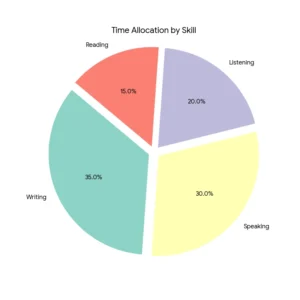
Visual Note: The pie chart shows how to distribute your 20-25 weekly study hours across the four skills for maximum score improvement.

This isn’t about neglecting Reading and Listening. It’s about maximizing score improvements where they matter most in limited time.


IELTS vs PTE vs CELPIP – Fast-Track Comparison Guide

Here’s what you need to know about each test for quick preparation:

Complete Test Comparison Table

Feature IELTS PTE CELPIP
Duration 2h 45min 2h 3h
Scoring Scale Band 0-9 10-90 CLB 1-12
Speaking Format Face-to-face interview Computer microphone Computer microphone
Writing Format Handwritten or typed Typed Typed
Scoring Method Human examiners AI algorithm Computer-based scoring
Results Time 5-13 days 48 hours 4-5 days
Test Dates 48 dates/year Daily availability 2-3 times/month
Fast-Track Difficulty Moderate Easier for tech-savvy Moderate
Best For Traditional learners Quick results needed Canada and Australia immigration
Price (USD approx) $215-250 $185-210 $280-300

IELTS Pros & Cons:

  • ✅ Widely accepted worldwide
  • ✅ Natural speaking test with human examiner
  • ✅ Familiar format to most learners
  • ❌ Subjective marking in Writing/Speaking
  • ❌ Slower results (5-13 days)
  • ❌ Limited test dates in smaller cities

PTE Pros & Cons:

  • ✅ Results in just 48 hours
  • ✅ Objective AI scoring (no examiner bias)
  • ✅ Flexible test dates (almost daily)
  • ❌ Requires adaptation to AI patterns
  • ❌ Less forgiving of pronunciation issues
  • ❌ Can feel mechanical and impersonal

CELPIP Pros & Cons:

  • ✅ Practical Canadian and Australian context scenarios
  • ✅ Clear audio quality
  • ✅ Familiar topics for Canada and Australia-bound applicants
  • ❌ Limited test locations outside Canada and Australia
  • ❌ Fewer practice resources available
  • ❌ Higher test fee

For the best English test for immigration, your choice depends on destination and personal strengths. Australia and UK increasingly accept all three. Canada recognizes IELTS, PTE, and CELPIP equally for most programs.


How Fast-Track Preparation Impacts Test-Takers

I’ve worked with three types of fast-track candidates:

Students applying for overseas education face semester intake deadlines they can’t postpone. Missing that score means waiting another 4-6 months and potentially losing scholarship opportunities. The pressure is real, but it’s also focused—they know exactly what score they need and why.

PR and migration candidates often have the most at stake. Their entire future in a new country depends on hitting specific point thresholds. For Canadian and Australian Express Entry, the difference between CLB 9 and CLB 10 can mean 50+ CRS points—enough to receive an invitation or remain in the pool indefinitely.

Working professionals with deadlines struggle most with time management. They’re preparing after work hours, often exhausted, trying to balance exam prep with job responsibilities and family life.

The common thread? Last-minute preparation fails when people treat it like casual learning. You can’t just “practice more” and hope for the best. You need structure, feedback loops, and strategic focus on scoring mechanisms.

According to research on intensive English preparation, concentrated study periods with specific goals produce better results than extended, unfocused learning. Your brain adapts faster when challenged consistently over shorter timeframes.


Benefits of a Structured 3-Week Fast Track Plan

Why does structure matter so much?

  • Clear daily focus reduces overwhelm: Instead of “I should practice English today,” you have “Today I’m mastering Listening Section 2 multiple choice questions.”
  • Faster familiarity with exam patterns: Repeated exposure to specific question types builds automatic recognition and response strategies.
  • Efficient use of mock tests: Rather than taking random practice tests, you use them diagnostically at specific intervals to measure progress and adjust focus.
  • Targeted improvement in weak modules: Data from your practice shows exactly which task types need work, eliminating guesswork.
  • Reduced exam anxiety: Knowing you’ve followed a proven plan builds confidence. You walk into the test center knowing what to expect.
  • Better time management under pressure: Structured practice with time limits trains you to work efficiently when every second counts.

The difference between short-term exam preparation and long-term language learning is focus. You’re not trying to become a better English speaker overall—you’re optimizing for a specific scoring system within a specific timeframe.


Step-by-Step Fast Track Study Plan (3 weeks)

 

Week 1 – Diagnostic & Strategy Setup

Start with a complete mock test under real exam conditions. Yes, all four sections, with proper timing. This is uncomfortable but essential.

Score it honestly using official marking criteria. Where did you actually lose points? Was it grammar in Writing Task 2? Missing keywords in Listening? Running out of time in Reading?

Based on these results, choose exam-specific resources. Don’t collect 50 different books. Pick 2-3 quality resources aligned with your test choice and weaknesses.

For IELTS preparation, I recommend Cambridge practice tests and official materials. For PTE, E2Language and APEUni provide AI-scored practice. CELPIP test-takers should focus on official Paragon Testing resources.

Week 2 – Skill-Specific Practice

This is where most people go wrong. They practice everything equally. Don’t.

Dedicate specific days to specific skills:

Writing: Learn templates and frameworks—not to memorize, but to understand successful structures. Practice writing Task 1 responses (describing data/processes) and Task 2 essays (argument essays) with strict 40-minute limits.

Speaking: Record yourself answering Part 2 topics. Listen back. Are you using discourse markers? Speaking at a steady pace? Extending your answers beyond basic responses?

Audio Example: Bad vs Good Speaking Answer

[Audio Player Placeholder: Listen to two responses to “Describe your favorite holiday destination” – one scoring Band 5.5 and one scoring Band 7.5. Notice the difference in structure, vocabulary range, and fluency.]

Bad Answer (Band 5.5): “Um… my favorite place is… beach. I go there… uh… with family. It is nice. Weather is good. I like swimming. Food is… tasty. That’s it.”

Good Answer (Band 7.5): “I’d have to say that my favorite holiday destination is definitely the coastal town of Galle in southern Sri Lanka. What I particularly love about it is the perfect blend of historical architecture and natural beauty. The 17th-century Dutch fort offers stunning ocean views, and you can spend hours exploring the ramparts during sunset. The local seafood is exceptional, especially at the small family-run restaurants near the harbor. I’ve been there three times now, and each visit reveals something new.”

Listening: Focus on prediction skills. Before each section plays, read questions and predict what information you need. Practice identifying keywords in audio.

Reading: Work on time control. Aim to spend no more than 20 minutes per passage. Practice skimming for main ideas and scanning for specific details.

Week 3 – Full Mock Tests & Error Analysis

Take 2-3 complete timed mocks this week under real conditions. No pausing, no checking answers mid-test.

After each mock, conduct detailed error analysis. Don’t just note wrong answers—understand why you got them wrong. Was it vocabulary? Misunderstanding the question? Running out of time?

Create error logs by question type. You might discover you consistently miss “True/False/Not Given” questions in Reading or struggle with “Describe Image” tasks in PTE Speaking.

For Speaking, record and review your responses. Listen like an examiner would. Are you answering the actual question asked? Using a range of grammar structures? Speaking clearly?

Exam Readiness & Fine-Tuning

Reduce intensity during your final week. This isn’t the time for marathon study sessions.

Do light revision of error patterns identified in Week 3. Practice your weakest question types, but don’t introduce completely new material.

Focus on confidence-building practice. Take one final mock test early in the week, then shift to shorter timed practices of individual sections.

Review exam-day strategy and pacing. Know exactly how much time to spend on each section. Prepare your documents, test center directions, and arrival schedule.

The night before your test, don’t study. Rest, hydrate, and visualize yourself performing well.


Common Mistakes to Avoid in Fast-Track Preparation

These IELTS preparation mistakes and PTE exam errors cost people their scores:

Memorizing essays instead of structure: Examiners recognize memorized content immediately. You’ll get penalized for off-topic responses. Learn frameworks, not full texts.

Ignoring scoring criteria: Each exam has published rubrics showing exactly what earns higher scores. Yet most people never read them. This is free information about what examiners want.

Practicing without feedback: Doing 50 practice writings without checking them against criteria is useless. You’ll just repeat the same mistakes 50 times. Get feedback from teachers, online platforms, or AI tools.

Choosing the wrong exam type: If you have strong spoken English but struggle with typing, PTE’s integrated tasks might hurt you. Match the exam to your strengths when possible.

Overloading vocabulary lists: Learning 2000 new words in three weeks sounds productive but rarely works. Instead, master using intermediate vocabulary accurately in context.

Skipping mock tests: Some students “save” official practice tests, thinking they’ll do them later when they’re “ready.” Wrong approach. Mock tests are diagnostic tools, not final exams. Use them early and often.


Conclusion

Fast-track preparation for IELTS, PTE, or CELPIP isn’t about taking shortcuts or finding magic tricks. It’s about precision, prioritization, and understanding exactly what these exams measure.

Can you improve significantly in three weeks? Absolutely—if you’re strategic about it. I’ve seen dozens of students achieve their target scores in this timeframe by following structured plans and avoiding common time-wasters.

The key is treating this like exam preparation, not general English improvement. Focus on scoring patterns, practice with purpose, and get feedback on your weak areas.

Your success comes down to three things: understanding the test format, practicing the right skills in the right proportion, and managing your time effectively both during preparation and on exam day.

If you’re serious about learning how to prepare for IELTS, PTE, or CELPIP in 3 weeks or less, the next step is committing to a structured plan designed for your specific situation and target score. The clock is ticking, but with the right approach, three weeks can be enough to change your results—and your future.


FAQs About Fast-Track IELTS, PTE, and CELPIP Preparation

Is 3 weeks enough to prepare for IELTS, PTE, or CELPIP?

Yes, three weeks can be sufficient if you already have intermediate English skills (roughly B1-B2 level) and need to improve by 0.5-1.0 band. The key is focused, strategic preparation rather than trying to learn English from scratch. If you’re starting from beginner level (A1-A2), you’ll need more time to build foundational language skills before tackling these exams effectively. Success in three weeks requires daily practice, structured study plans, and ideally some form of feedback on your performance.

PTE often allows for the fastest score improvements in short timeframes, particularly for test-takers comfortable with technology and those who have clear pronunciation. The automated scoring system is predictable once you understand its patterns. IELTS and CELPIP can also work well for fast preparation if you have strong conversational English skills, as the Speaking components feel more natural. The “easiest” test ultimately depends on your individual strengths—analytical thinkers often prefer PTE’s systematic approach, while natural communicators might find IELTS Speaking more comfortable.

Beginners with limited English foundation (A1-A2 level) shouldn’t attempt fast-track preparation. These programs work best when you already have intermediate comprehension and can hold basic conversations. If you struggle with simple grammar, vocabulary, or understanding everyday English, spend 2-3 months building foundational skills first. However, if you’re an intermediate learner who simply hasn’t taken the exam before, fast-track preparation focusing on test strategies and format familiarity can work very well. Be honest about your starting point—taking the exam before you’re ready wastes money and hurts confidence.

Plan for 3-4 hours of focused daily study if you’re preparing over three weeks. This includes active practice (writing essays, speaking responses, timed reading sections) and review time (analyzing errors, understanding scoring criteria). Working professionals might split this into 2 hours before work and 2 hours in the evening. Students might do one longer session. Quality matters more than quantity—three hours of targeted practice with feedback beats six hours of passive reading. Allow one rest day per week to prevent burnout. In your final week, reduce to 1-2 hours daily to avoid exhaustion.

Ready to Start Your Fast-Track Journey?

Don’t leave your exam score to chance. Whether you need IELTS for university, PTE for Australian immigration, or CELPIP for Canadian and Australian PR, a personalized study plan designed around your schedule, target score, and learning style makes all the difference.

Get a free diagnostic assessment to identify your current level and exact areas for improvement. Our expert-guided fast-track preparation programs have helped over 3,000 students achieve their target scores in record time.

Schedule your consultation today and take the first confident step toward your goals.

Related Blog Posts

As a migration consultant at Zen Student Academy, I’ve reviewed hundreds of Sri Lankan applicant profiles over the years, and the single most common mistake I see is this: someone picks a country because a friend moved there, or because they watched a YouTube video, not because it actually fits their profile. This guide breaks […]

The Two-Minute Test That Trips Up Even the Smartest Students Then the examiner at your British Council or IDP Sri Lanka test centre hands you a cue card, gives you one minute to prepare, and suddenly – your mind goes blank. That two-minute monologue in IELTS Speaking Part 2 is where most Sri Lankan candidates […]

“Do you really need a fast-track course, or do you first need to strengthen your English foundation?” That is the question we ask every student who walks into Zen Student Academy and says, “I want to join the fast-track programme.” And honestly? A lot of them are surprised by the answer. We have worked with […]

You have been studying for weeks. Maybe months. You have watched YouTube tutorials, practiced every question type you can find, and sat the exam, only to see the same score staring back at you. Here is what most PTE prep guides still will not tell you: you might be working hard on the wrong things. […]

Last Updated: March 2026 Whether you have just registered for IELTS or are about to, you face a critical choice. By June 27, 2026, the traditional paper-based format will be phased out globally. The format decision you make today has a direct impact on your results, your preparation strategy, and your application timeline. IMPORTANT: Paper-based […]

“You’ve finished your O/Ls or A/Ls — now every parent, relative, and neighbour has a different opinion on what you should do next. Sound familiar?” At Zen Student Academy, we speak to hundreds of Sri Lankan students every year who are in exactly this moment. Results are out. Pressure is mounting. And there are more […]