
The Two-Minute Test That Trips Up Even the Smartest Students
Then the examiner at your British Council or IDP Sri Lanka test centre hands you a cue card, gives you one minute to prepare, and suddenly – your mind goes blank.
That two-minute monologue in IELTS Speaking Part 2 is where most Sri Lankan candidates lose the band score they have been working months to earn. Not because they lack English – but because they lack a system.
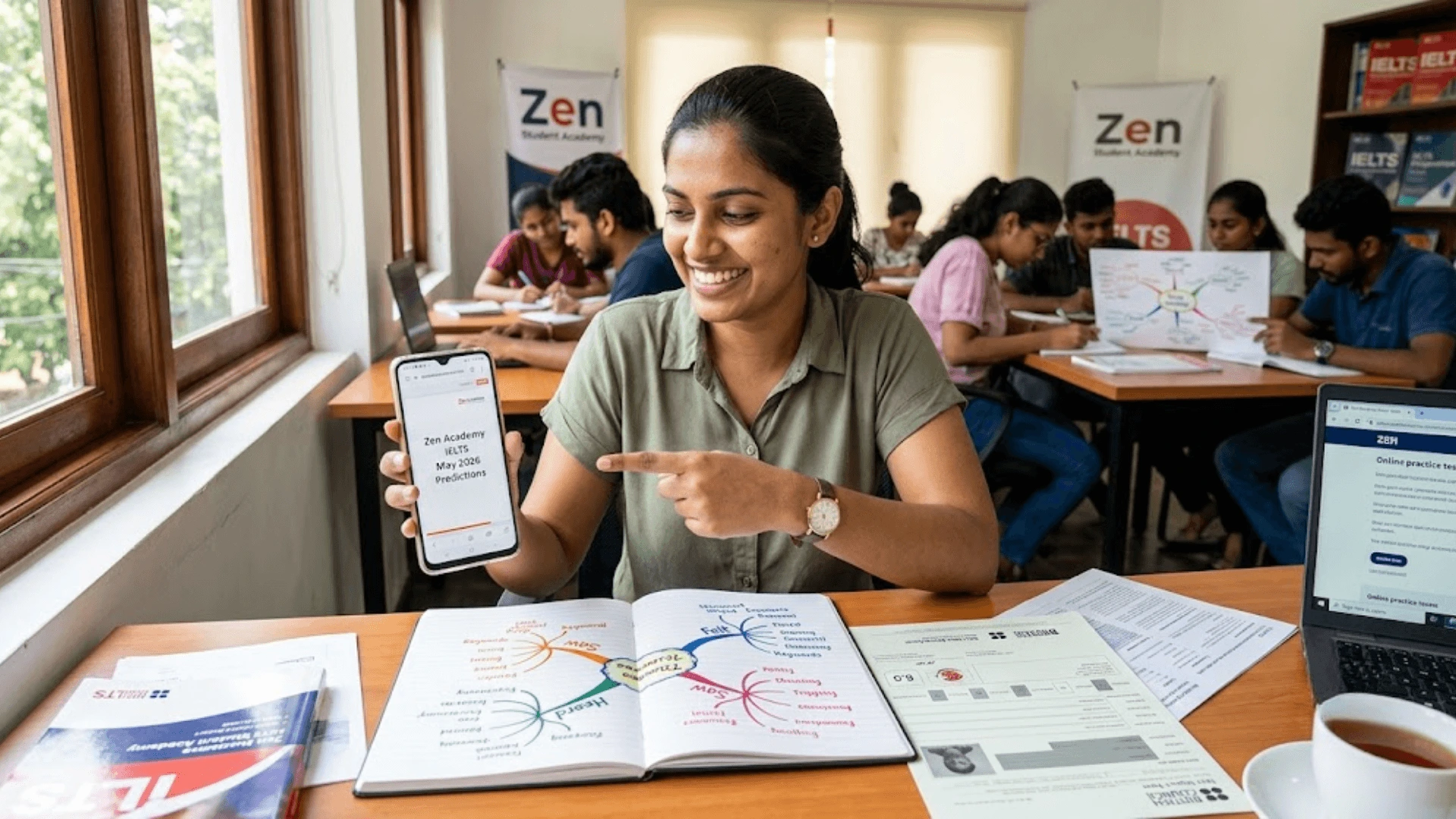
One of our recent students, Nadeesha, sat her exam at the British Council in Colombo this past April. She drew an unfamiliar cue card about a historical period she had never thought about before. Instead of freezing, she used our “Three-Senses” mind-map technique – and turned that blank moment into a Band 7.5 speaking performance. That is not luck. That is methodology.
What is the Zen "Three-Senses" Mind-Map?
It is a rapid 60-second sketching framework that trains your brain to group descriptive details by what you saw, what you heard, and how you felt. This bypasses the need to translate from your native language and gives you three natural branches of ideas to speak from – enough to fill two full minutes with confidence.
At Zen Student Academy, guided by IELTS expert Shiney Umaya, we have spent years studying exactly why candidates freeze, stumble, or run out of ideas after 45 seconds. We have built a preparation system that directly addresses these challenges – combining strategic mind-mapping, structured delivery practice, and the most accurate IELTS Speaking Part 2 cue card predictions for May-June 2026.
From Colombo to Kandy, our students are walking out of British Council and IDP exam halls with Band 7, 7.5, and 8 scores.
Student Success: Real Certificates, Real Band Scores


Zen Student Academy IELTS Band 7, 7.5, 8 and 8.5 Success Certificates – Sri Lankan students achieving top scores at British Council and IDP Colombo, 2025-2026.
Real results from real students. Recent Zen Student Academy graduates from Sri Lanka who achieved Band 7+ using our structured IELTS Speaking Part 2 methodology.
These are not cherry-picked wins. These are the consistent outcomes of students who committed to the right preparation process. Want to add your certificate here? Start your preparation with us today
Why Do Sri Lankan Students Struggle with the IELTS Speaking Exam?
Here is the honest truth: most IELTS candidates prepare the wrong way.
They memorise model answers, recite scripted responses, and practise speaking at a topic rather than about it. When the examiner changes a single word in the cue card prompt, the whole script collapses.
For Sri Lankan students specifically, there are additional challenges that standard IELTS prep materials rarely address:
- Mother-tongue influence: Sinhala and Tamil sentence structures often carry over into English, affecting the natural flow examiners reward
- Running dry after 45 seconds: Candidates describe the “what” but forget the “why” and “how” that push scores into Band 7 territory
- Grammatical freezing: Mid-sentence hesitation breaks fluency and directly impacts the score
- Topic panic: Seeing an unfamiliar cue card and losing confidence immediately
- Over-rehearsed answers: Examiners at British Council Colombo and IDP Sri Lanka can tell when a response is memorised – it limits the naturalness score
Shiney's Top Tip: Stop Memorising, Start Mapping
“The biggest mistake I see from students in Sri Lanka is translating their ideas from Sinhala or Tamil into English while they are speaking. That split-second translation is what causes hesitation. Our mind-mapping method trains you to think in English topic structures, not translate into them. Once students make that shift, their fluency scores jump almost immediately.”
– Shiney Umaya, Founder, Zen Student Academy
Our approach teaches you a mind-mapping technique that generates ideas on the spot from any cue card. We pair that with structured fluency drills built around the most likely May 2026 exam topics – so you are practising smart, not just practising more.
According to the British Council’s IELTS preparation guidance, candidates who understand all four assessment criteria – fluency, vocabulary, grammar, and pronunciation – and practise each one separately tend to score significantly higher than those who treat speaking as one undifferentiated skill.
How Often Do IELTS Cue Cards Change?
This is one of the most practical questions any IELTS candidate should ask before they start preparing.
IELTS Speaking topics rotate on a three-cycle annual schedule: January-April, May-August, and September-December. Each new window introduces a refreshed pool of cue cards, though some topics carry over between cycles.
What this means for you: if you are sitting your exam in May or June 2026 at British Council Sri Lanka or IDP Colombo, the predictions below are directly relevant to the active topic pool right now. Practising topics from the January cycle – or worse, from last year – is wasted preparation time.
At Zen Student Academy, we track these rotations carefully and cross-reference with reported exam experiences from students across Sri Lanka. When you practise with our May 2026 predictions, you are not guessing – you are preparing with purpose.
Latest IELTS Speaking Part 2 Predictions - May and June 2026
Compiled and verified by the Zen Student Academy academic team | May 2026
📥 Download Your Free Cue Card Practice Pack The questions below are taken directly from our official Latest IELTS Speaking Questions – May & June 2026 – Part 2 prediction sheet, prepared by the Zen Student Academy academic team.
Want the full printable PDF version to practise offline?
💬 WhatsApp us: +94 71 116 5977
📧 Email: zenstudentlk@gmail.com
Your Future Begins Here…
The cue cards below are Zen Student Academy’s own predictions for the current May-August 2026 testing window, drawn from our ongoing tracking of reported exam topics across Sri Lanka. Do not just read them – practise each one using our Three-Senses mind-mapping method: Who, What, When, Why, and How you felt. That framework works for every single prompt below.
People, Relationships, and Interactions
These topics test your ability to speak personally and emotionally – two qualities that naturally boost coherence and vocabulary scores. Sri Lankan students often excel here because of the strong community and family culture – use that to your advantage.
1. A Person Who Influenced Your Life
Describe a person who has had a significant influence on your life.
You should say:
- Who the person is
- How long you have known him / her
- What qualities this person has
- Explain why this person has had such an influence on you
2. A Promise You Made
Describe a time you made a promise to someone.
You should say:
- Who you made a promise to
- What the promise was
- Why you made the promise
- And explain if you were able to keep the promise or not
3. An Apology
Describe a time you had to apologise to someone.
You should say:
- Who the person was
- Why you needed to apologise to them
- What their reaction was
- How you felt about the situation afterwards
4. An Interesting Conversation with a Stranger
Describe an interesting conversation you had with a stranger.
You should say:
- Where the conversation took place
- What the conversation was about
- What made it interesting
5. Giving Advice
Describe a time when you gave advice to someone.
You should say:
- Who you gave the advice to
- What the advice was
- How they responded to your advice
- And explain why you thought it was good advice to give
6. Helping Someone
Describe a time when you helped someone.
You should say:
- Who you helped
- How you helped them
- Why you helped them
- And explain how you felt afterwards
7. A Beautiful or Handsome Person
Describe a person you have seen who is beautiful or handsome.
You should say:
- Who the person is
- Where you saw them
- What they were doing
- And explain why you found them attractive
Personal Experiences, Emotions, and Milestones
Examiners love these topics because they generate natural emotional vocabulary – exactly what separates Band 6 from Band 7+.
8. A Memorable Event
Describe a memorable event you have attended in the past.
You should say:
- What the event was
- Where and when it happened
- What you saw or did
- And explain why it was memorable
8b. An Event You Enjoyed
Describe an event you enjoyed a lot.
You should say:
- What the event was
- Where it was
- Who was there
- And explain why you enjoyed it
9. Waking Up Very Early
Describe a time when you had to wake up very early.
You should say:
- When it was
- Why you had to wake up so early
- Where you were going
- And explain how you felt about waking up so early
10. A Very Busy Period
Describe a time when you were very busy.
You should say:
- When this time was
- What you did at this time
- How you arranged your time
- And explain how you felt after this busy time was over
11. Receiving Good News
Describe a time when you received good news.
You should say:
- When you received this news
- What the news was about
- How you received this news
- And explain how you felt about it
12. A Time You Were Really Happy
Describe a time when you were really happy.
You should say:
- When and where this was
- Who you were with
- What you did
- And explain why you were happy at this time
12b. Seeing Lots of People Smiling
Describe a time when you saw lots of people were smiling.
You should say:
- When and where you saw it
- What the people were doing at the time
- Why they were happy
- And explain how that made you feel
13. Trying Something Unsuccessfully
Describe a time when you tried to do something but were not very successful.
You should say:
- When this was
- What you tried to do
- Why you were not successful
- And explain how you felt about this
14. Moving to a New Place
Describe a time when you moved to a new school or home.
You should say:
- When you moved
- Where you moved to
- Who you moved with
- And explain how you felt about it
15. A Positive Change
Describe a positive change in your life.
You should say:
- What the change was
- When it happened
- How it affected your life
- And explain why it was a positive change
16. Receiving Incorrect Information
Describe an occasion when you received incorrect information.
You should say:
- When and where it happened
- Who gave you the information
- What the incorrect information was
- How you found out it was incorrect
- And explain how you felt about it
Journeys, Leisure, and Activities
These cue cards reward descriptive language and sensory detail – a great opportunity to showcase vocabulary range.
17. A Long Walk
Describe a long walk you went on.
You should say:
- Where you went
- Who you went with
- What you saw
- And explain why you enjoyed the walk
18. A Boat Journey
Describe a journey you have made by boat.
You should say:
- Where you went
- Why you went on this journey
- Who you went with
- And explain how you felt during this journey
19. A Sea Activity You Want to Try
Describe a leisure activity near or on the sea that you want to try.
You should say:
- What activity you would like to try
- Where you would do this activity
- Who you would do this activity with
- And explain why you would like to try this activity
20. A Historical Period
Describe a historical period you would like to visit.
You should say:
- What the period is
- Where this place is
- What you would do there
- And why you want to visit this period
Media, Art, and Objects
These topics test your ability to analyse and evaluate – skills that push your score firmly into the 7-8 range.
21. A TV Programme You Did Not Enjoy
Describe a television programme that you watched and did not enjoy.
You should say:
- What the programme was
- How you came to watch it
- What it was about
- And explain why you did not enjoy it
22. A Film or Show That Made You Laugh
Describe a film or TV show that made you laugh.
You should say:
- What film or TV show it was
- When and where you watched it
- What it was about
- And explain why it made you laugh
23. A Programme That Made a Strong Impression
Describe a television program that has made a strong impression on you.
You should say:
- What the television program is
- What it is about
- When you first watched it
- And explain why it has made such a strong impression on you
24. A Piece of Art You Like
Describe a piece of art (for example, a painting or sculpture) that you like.
You should say:
- What the work of art is
- When you first saw it
- What you know about it
- And explain why you like it
25. A Holiday Souvenir
Describe something special you brought home from a holiday.
You should say:
- What it was
- When and where you went on this holiday
- What you did with it after you brought it home
- And explain why you thought it was special
26. A Piece of Clothing You Enjoy
Describe a piece of clothing you enjoy wearing.
You should say:
- Where you got it from
- What it looks like
- When you wear it
- And explain why you enjoy wearing it
27. Receiving Money as a Gift
Describe a time when you received money as a gift.
You should say:
- Who gave you the money
- Why they gave it to you
- What you did with the money
- And explain how you felt after receiving this gift
Health and Food
Seemingly simple, but candidates often underestimate how much specific vocabulary and structure these topics demand.
28. Trying a New Food
Describe a time when you tried a new food for the first time.
You should say:
- Where you were
- What you ate
- How you felt about it
- And explain why you decided to try this new food
29. Taking Medicine
Describe a time when you had some medicine.
You should say:
- What you had to eat or drink
- How often you had to take it
- Why you had to take it
- And explain how it helped you or any side effects you had from it
How to Use These IELTS Speaking Predictions Effectively
Your 3-Step Practice Method for Band 7+
Knowing the topic is only step one. Here is what separates a Band 6 answer from a Band 7+ answer at IDP and British Council Sri Lanka exam centres:
✏️ Step 1 – Mind-map during your 1-minute prep time, do not script. Jot down 4-5 trigger words across the Who / What / When / Why framework. Do not write full sentences. The goal is launching points, not a script.
🗣️ Step 2 – Speak for the full 2 minutes. Most candidates stop at 1:20. Train yourself to keep expanding with personal opinions, comparisons, and reflections. Ask yourself: “What did this make me think about? What would I do differently?”
🔀 Step 3 – Layer your tenses deliberately. A strong Part 2 answer moves naturally through past narration, present reflection, and sometimes hypothetical future thinking. That tense variety directly signals grammatical range to your examiner.
According to IELTS.org’s official scoring criteria, fluency and coherence carry equal weight to vocabulary and grammatical range. You do not just need good words – you need to flow.
Frequently Asked Questions
Are these May 2026 IELTS Speaking predictions guaranteed to appear in my exam?
No prediction is guaranteed – but these topics are drawn from active rotation patterns and reported exam experiences from candidates at British Council Sri Lanka and IDP Colombo during the May-August 2026 window. Practising them gives you a clear strategic edge.
How many cue card topics should I practise before my IELTS exam?
Focus on depth over breadth. Practising 15-20 topics thoroughly – with full 2-minute responses and Part 3 follow-ups – is more effective than skimming through 50 topics superficially.
Does mother-tongue influence from Sinhala or Tamil affect my IELTS Speaking score?
It can – but it does not have to. Examiners assess clarity and fluency, not accent. What matters is whether your speech flows naturally. Our methodology specifically trains Sri Lankan students to reduce translation-lag and speak more fluently.
When do the May 2026 IELTS topics rotate to the next cycle?
The September 2026 cycle typically activates in late August. If your exam is before then, these predictions remain directly relevant.
Your Next Step Toward IELTS Band 7+
Here is the truth most IELTS prep courses will not tell you: the predictions alone will not get you the score.
What gets you the score is delivery – the ability to take any topic, organise your thoughts in 60 seconds, and speak clearly and confidently for two full minutes. That is a learnable skill. But it develops faster with the right coaching and structured feedback.
At Zen Student Academy, Shiney Umaya and our expert team work with students one-on-one and in focused group sessions to close the gap between where you are now and where you need to be. We do not just hand you topic lists. We fix the way you speak under exam pressure – with specific attention to the challenges Sri Lankan students face at British Council and IDP test centres.
Read more student success stories and band score certificates
Ready to join students from Colombo to Kandy who are walking out of their IELTS exams with Band 7, 7.5, and 8 scores?
Enrol at Zen Student Academy Today - Limited Seats for May 2026 Prep
Seats for our May-June 2026 IELTS Speaking intensive are filling fast. Do not leave your band score to chance.
- 📞 Book your free consultation call
- 💬 WhatsApp us: +9471 116 5977
- 📧 Email: zenstudentlk@gmail.com
Your exam is coming. Your preparation starts now.
Published by Zen Student Academy | Last Updated: May 2026 Written under the guidance of Shiney Umaya, IELTS Coach and Founder of Zen Student Academy Predictions verified as of May 2026 by the Zen Student Academy academic team.

Shiney
Shiney Umaya is an IELTS, PTE, CELPIP and Business English expert with over 10 years of coaching experience. As the founder of Zen Student Academy and a Cambridge & University of London certified teacher, she is dedicated to helping students achieve Band 7+ scores and unlock their global potential.