
Last Updated: March 2026
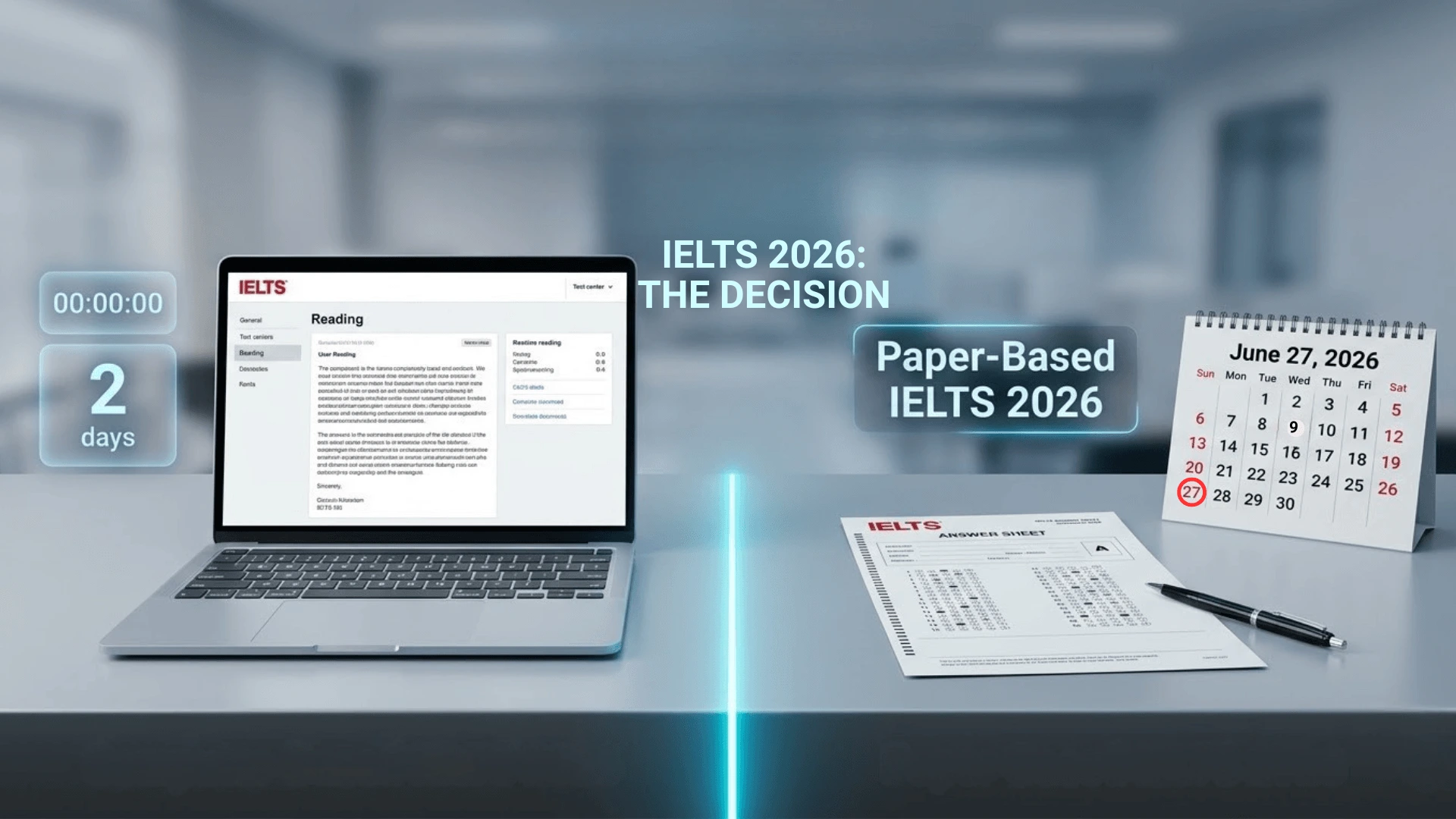
Whether you have just registered for IELTS or are about to, you face a critical choice. By June 27, 2026, the traditional paper-based format will be phased out globally. The format decision you make today has a direct impact on your results, your preparation strategy, and your application timeline.
IMPORTANT: Paper-based IELTS will no longer be available globally after June 27, 2026. If you are planning to sit the paper-based test, you must book and complete your exam before this date. After June 27, computer-delivered IELTS will become the standard format worldwide.
At Zen Student Academy, we have spent over 12 years coaching Sri Lankan students through IELTS, and this format question comes up with almost every single student we work with. The truth is, both formats test the same skills at the same difficulty level. But picking the wrong format for your strengths can quietly cost you marks, not because the test is harder, but because you feel uncomfortable during it.
In 2026, IELTS introduced several important changes including the phase-out of paper-based testing, a new Writing on Paper hybrid option, and a One Skill Retake policy. Every candidate needs to understand these changes before test day. Our coaching team breaks down all the key differences, the latest updates, the pros and cons of each format, and a simple framework to help you decide.
IELTS Computer vs Paper-Based: Key Differences at a Glance
Before going deeper, here is a quick side-by-side comparison.
| Feature | Computer-Based IELTS | Paper-Based IELTS |
| Test format | On screen | Written on paper |
| Writing method | Keyboard typing | Handwritten |
| Result time | 1 to 3 days | Around 13 days |
| Test availability | Multiple times per week | Limited dates, ends June 27, 2026 |
| One Skill Retake | Available | Not available |
| Writing on Paper option | Rolling out now (check local center for availability) | Not applicable |
| Speaking test | Same face-to-face format | Same face-to-face format |
| Best for | Fast typists, fast results | Handwriting preference, book before June 2026 |
One important point upfront: the Speaking test is identical in both formats. You always sit face-to-face with a certified examiner. There is no AI scoring involved.
What's New in IELTS in 2026?
IELTS is not a static exam. IDP and British Council regularly update their processes, and 2026 has brought some of the most significant changes in the test’s history. You can read the official IELTS 2026 update from IDP and the British Council IELTS test delivery update for the full official announcements.
Paper-based IELTS is ending on June 27, 2026. This is the biggest operational change IELTS has ever made. After this date, computer-delivered IELTS becomes the only standard format globally. If you still want to sit the paper-based test, you need to book now.
Black pen replaces pencil for paper-based tests. For any remaining paper-based sittings before June 27, candidates must use a black ballpoint pen. Modern scanners often misread pencil reflections as blank spaces, which means a correctly written answer can be missed and marked wrong. Black ink ensures high contrast so the automated grading system registers every word accurately. There is a full section on this below with practical tips.
Expanded computer test availability. More test centers globally now offer computer-based IELTS, making flexible booking easier than ever. This is especially true in South Asia. In Sri Lanka, both British Council and IDP centers in Colombo and Kandy now offer frequent computer-based slots throughout the week.
Faster digital result processing. Results are faster than ever in 2026. You will typically receive your score within 1 to 3 days with the computer-delivered format. Some British Council and IDP centers in Sri Lanka have even reported next-day results during lower-volume periods.
One Skill Retake (OSR): This is the single biggest reason to choose the computer format. If you fall short of your target in just one area, for example Writing, you can retake only that section for a fraction of the cost of a full test. This policy is only available for computer-delivered IELTS, not paper-based. We advise every student preparing for a visa or university application to factor this into their test strategy from day one. It changes the entire risk calculation of sitting IELTS.

New Writing on Paper hybrid option. As the paper-based test ends, a new hybrid option is rolling out now at selected centers. Here is exactly how it works:
- Listening: Completed on a computer
- Reading: Completed on a computer
- Writing: Handwritten on paper using a black ballpoint pen
- Result time: Aligned with computer-based results, typically 1 to 3 days
This makes it a best-of-both-worlds choice for candidates who are comfortable navigating on screen but think and write more naturally by hand. Check with your local IDP or British Council center to confirm availability in your city.
Updated test interfaces. The computer-based platform has improved its reading navigation tools, making it easier to flag questions, highlight text, and move between sections during the exam.
For the most current test center information and booking dates, check the official IELTS website at ielts.org directly.
The Big Change: Why Paper-Based IELTS Now Requires a Black Pen

This is the update that has caught the most candidates off guard.
For years, paper-based IELTS candidates used pencils, especially for the Listening and Reading sections. In 2026, many test centers have officially moved to black ballpoint pens for the entire paper-based exam.
Why did this change happen? Think of it like a photocopy. If you write with a light pencil, the copy comes out faded and unreadable. If you use a bold black pen, the copy is sharp and clear. The IELTS automated grading system works the same way.
Here is the science behind it: graphite, the material in pencils, reflects light. During high-speed digital scanning, this reflection creates a glare that makes your text look invisible to the AI grading software. The system reads that glare as a blank space, which means a correct answer can be marked wrong even though you wrote it down. Black ink does the opposite. It absorbs light and creates the high-contrast image the scanner needs for a 100 percent accurate read. Every letter registers, every correct answer gets counted.
What this means for you practically:
Bring at least two black ballpoint pens to your test. Avoid gel pens because they can smudge before drying, especially under time pressure. Rollerball pens are generally acceptable, but ballpoints are the safest and most reliable choice. Most importantly, start practicing your handwritten essays and answers with a pen right now, not a pencil.
If you have been doing all your practice with a pencil, this is the time to switch. Writing speed and hand fatigue can feel noticeably different with a pen, particularly during a 60-minute Writing section.
Zen Student Academy tip:
We have seen students cramp up during Writing Task 2 because they never practiced with a pen under timed conditions. This comes up repeatedly in our coaching sessions. Do a few full timed essays with a ballpoint pen this week and pay close attention to how your hand feels at the 35-minute mark.
Digital IELTS: Key Benefits of the Computer Format
There are some genuinely compelling reasons why computer-based IELTS has become the preferred format in most countries.
Faster Results:
You will typically receive your score within 1 to 3 days using the computer-delivered format. If you are applying to a university with a close deadline or need to submit your score quickly for a visa application, this is a huge practical advantage over waiting 13 days for paper-based results.
One Skill Retake (OSR):
KEY BENEFIT: The One Skill Retake acts as your safety net, allowing you to fix one bad day without restarting the entire process. If you miss your target band in one section, you retake only that section rather than the full exam. The retake must be completed within 60 days of your original test date and costs a fraction of a full sitting. This option is not available for paper-based IELTS. For Sri Lankan candidates who are already close to their target score, the OSR policy removes the biggest risk of sitting the test. Read our full One Skill Retake guide for a complete breakdown of how to use this policy strategically.
More Flexible Test Dates:
Computer-based IELTS runs multiple times per week at most centers. You are not locked into a handful of dates per month, which makes it much easier to fit the test into your preparation timeline and schedule.
Easy Editing While You Write:
You can cut, copy, paste, and rewrite freely. If you realize halfway through your essay that your paragraph structure is off, fixing it takes seconds. On paper, that means crossing out words, squeezing in additions, and potentially making your script harder for the examiner to follow.
Built-In Word Count:
The computer interface shows your word count in real time. This helps you stay above the minimums, which are 150 words for Task 1 and 250 words for Task 2 in Academic IELTS, without having to count manually during the exam.
Better Reading Navigation:
Highlighting text, using on-screen flags for uncertain questions, and scrolling between passages makes the Reading section more manageable for many candidates, particularly those who regularly read long-form content on screens.
Disadvantages of Computer-Based IELTS
Typing Speed Is Critical:
If you type slowly, you will spend more mental energy on the physical act of typing and less on the quality of your essay. A candidate who types 30 to 40 words per minute under pressure may struggle to produce a well-developed Task 2 essay within 40 minutes. Check your typing speed before committing to this format.
Screen Fatigue:
The Reading section alone involves three long academic passages. You complete this after the Listening section, so your focus is already stretched. For some candidates, extended screen reading causes real eye strain by the end.
Ask yourself honestly before you commit to this format:
- Do you regularly read long articles on a screen without discomfort?
- Can you stay focused on dense academic text on a laptop or phone for 60 minutes?
- Do you work or study in front of a screen for several hours each day?
If your answer to most of these is no, screen fatigue is a genuine risk worth planning for.
Technical Comfort Required:
Some candidates, particularly those from less digitally connected backgrounds, simply feel more at ease with pen and paper. Unfamiliarity with the keyboard layout or the computer interface can create unnecessary anxiety on test day.
Advantages of Paper-Based IELTS

Note: Paper-based IELTS ends globally on June 27, 2026. The advantages below only apply if you book and sit your test before that date.
Despite the computer format becoming the global standard, paper-based IELTS still has genuine advantages for the right candidate.
Natural Writing Flow:
Many candidates think more clearly when writing by hand. The physical act of writing engages memory and creativity differently for some people, and their ideas simply flow more naturally onto the page.
Easier Reading for Many People:
Long academic texts are still more comfortable on paper for many readers. You can physically underline keywords, circle important ideas, and annotate passages directly on the page, which can speed up comprehension during the Reading section.
Familiar Exam Environment:
If you have spent your academic life doing handwritten exams, paper IELTS will feel intuitive. There is no interface to learn, no keyboard to worry about, and no screen between you and the test.
The Handwritten Test Is Ending: Disadvantages of Paper-Based IELTS

Slower Results:
Paper-based results take around 13 days. If your application deadline is tight, this is a serious practical problem that could affect your plans.
Fewer Test Dates:
Paper-based tests are offered less frequently, typically only a few times per month. If you need to reschedule or retake quickly, your options are very limited.
No Easy Editing:
Crossed-out text, squeezed-in additions, and messy revisions can make your Writing answers harder to read. Examiners are trained to handle imperfect scripts, but clean and legible writing always presents your ideas more clearly.
It Is Being Discontinued:
The most significant disadvantage of paper-based IELTS in 2026 is simply that it will not exist after June 27. There is no practical reason to build comfort with a format that is being retired. If you are preparing now, the smart investment is getting confident with the computer-delivered format.
IELTS Academic vs General vs UKVI: Does the Format Matter?
Short answer: no, not in terms of difficulty.
Both computer-based and paper-based options are currently available for all three test types.
IELTS Academic is for university admissions and professional registration. IELTS General Training is for migration and work visas. IELTS UKVI is a specific version required by the UK Home Office for certain visa types. The content is identical to standard IELTS. The only difference is stricter security and ID checks required at the test center.
The content, marking criteria, and band score calculation are identical across both delivery formats. Whether you sit at a screen or pick up a pen, you are being assessed on the same skills. The format is purely a delivery mechanism, not a difficulty variable.
For IELTS UKVI in particular, confirm that your chosen test center is approved for the specific visa category you are applying for. You can verify this on the UK Visas and Immigration approved test list.
Where Can You Take Computer vs Paper-Based IELTS?
Computer-based IELTS is now available in most major cities across the UK, Canada, Australia, Singapore, India, Sri Lanka, the UAE, and dozens more countries.
For Sri Lankan candidates specifically, computer-based IELTS is currently active at the following locations.
| City | Center | Format Available |
| Colombo | British Council Sri Lanka | Computer and Paper |
| Colombo | IDP Sri Lanka | Computer and Paper |
| Kandy | IDP Kandy | Computer and Paper |
| Batticaloa | IDP (regional) | Computer-based |
| Matara | IDP (regional) | Computer-based |
| Kurunegala | IDP (regional) | Computer-based |
| Jaffna | Check with IDP directly | Subject to availability |

Test fees in Sri Lanka, current as of March 2026: British Council charges approximately LKR 74,000 and IDP charges approximately LKR 70,000 for the standard IELTS test. Fees apply to both Academic and General Training. LKR exchange rates can fluctuate, so always confirm the current fee directly on the IDP Sri Lanka website or the British Council Sri Lanka website at the time of booking.
Ready to book? Go directly to the booking pages: Book your IELTS test with IDP Sri Lanka Book with British Council Sri Lanka
You can also check available IELTS dates in Sri Lanka on the IDP portal before registering to find the dates that suit your preparation timeline.
Paper-based tests remain available at Colombo and Kandy centers, but only until June 27, 2026. After that date, all centers will transition exclusively to computer-delivered IELTS.
Practical advice: Check availability on the IDP or British Council booking portal for your specific location before committing to a format. In some areas, your preferred format may have limited upcoming dates, which could affect your preparation timeline.
Which Countries Have Already Dropped Paper-Based IELTS?
Not every country is on the same timeline. Some moved to computer-only before the official mid-2026 global deadline. Others still offer both formats with limited paper slots. Here is a confirmed breakdown as of March 2026 so you can plan your booking with confidence.
Countries that have already moved to computer-only:
Bangladesh ended paper-based IELTS in February 2026. Bahrain and Jordan both discontinued paper-based testing from February 8, 2026. Vietnam, Malaysia, Pakistan, and Nigeria completed their transition to computer-only testing during 2024 and 2025. Taiwan and Uzbekistan are scaling back and in the process of full transition now.
Countries where both formats are currently available but paper is limited:
In the UK, Australia, New Zealand, Canada, and many European countries, paper-based IELTS is still technically available at selected centers. However, dates are infrequent and most capacity has shifted to computer-based. The majority of test-takers in these countries already use computer-based by choice.
In India, IDP is expected to offer around 48 paper-based dates across major cities in 2026 alongside daily computer-based slots. Both formats remain genuinely available there for now.
Countries where paper-based is available for residents only:
In Japan, South Korea, Singapore, Thailand, Indonesia, and Hong Kong, paper-based IELTS is restricted to candidates who are legally residing in that location. Non-residents and cross-border candidates cannot register. This restriction was introduced to reduce exam security risks observed primarily among non-resident candidates.
One significant reason behind the global push to end paper-based testing is exam security. Multiple markets have seen question leaks and the selling of answer sheets tied specifically to the paper format. Moving to computer-delivered testing makes it far harder to exploit these vulnerabilities.
For Sri Lanka: both formats are currently available at British Council and IDP centers in Colombo and Kandy until June 27, 2026. After that date, all Sri Lankan centers transition to computer-only, in line with the global deadline.
The bottom line is straightforward. If your country is not yet computer-only, it will be by mid-2026. The direction of travel is the same everywhere. The only question is whether paper-based is still an option where you are sitting the test right now.
| Country or Region | Paper-Based Available? | Notes |
| Bangladesh | No | Ended February 2026 |
| Bahrain | No | Ended February 2026 |
| Jordan | No | Ended February 2026 |
| Vietnam | No | Ended 2024 to 2025 |
| Malaysia | No | Ended 2024 to 2025 |
| Pakistan | No | Ended 2024 to 2025 |
| Nigeria | No | Ended 2024 to 2025 |
| Taiwan | Being phased out | Scaling back now |
| Uzbekistan | Being phased out | Scaling back now |
| Japan, South Korea, Singapore | Residents only | Not open to cross-border candidates |
| Thailand, Indonesia, Hong Kong | Residents only | Not open to cross-border candidates |
| India | Yes, limited dates | Around 48 paper dates in 2026 |
| UK, Australia, Canada | Yes, limited dates | Low frequency, most have switched to computer |
| New Zealand, Europe | Yes, limited dates | Low frequency, most have switched to computer |
| Sri Lanka | Yes, until June 27, 2026 | All centers switch to computer-only after this date |
| Global (all countries) | No, after June 27, 2026 | Computer-delivered IELTS becomes the only format worldwide |
Always verify availability for your specific city and center on the IDP or British Council booking portal before you register, as timelines can change ahead of the global deadline.
Which IELTS Format Is Easier?
Neither format is inherently easier. Full stop.
The band descriptors, question types, and scoring are identical. What differs is the experience of taking the test. Use this quick reference to guide your decision.
| What you prefer | Best format |
| Fast typing | Computer IELTS |
| Writing by hand | Computer IELTS with Writing on Paper option |
| Faster results | Computer IELTS |
| Traditional exam feel | Paper IELTS, but book before June 27, 2026 |
| Flexible test dates | Computer IELTS |
| One Skill Retake option | Computer IELTS only |
The format that matches your strengths and daily habits is the right one for you.
How to Choose the Best IELTS Format for You
Ask yourself these four questions honestly before you book.
First, are you comfortable typing essays under time pressure? If you regularly type at 50 or more words per minute and are used to composing written work on a keyboard, computer-based is likely a strong fit.
Second, do you read better on screen or on paper? Think about your daily habits. If you read long articles on your phone or laptop regularly, screen reading during the exam will not be an issue.
Third, how quickly do you need your results? If you have a visa application or university deadline within two weeks of your test, computer-based is the only sensible choice.
Fourth, what formats are available at your nearest test center? This practical filter often narrows the decision before anything else does.
Expert Tips for IELTS Candidates in 2026
These are the same IELTS preparation tips our coaches give every student before they book their IELTS test.
Practice in your chosen format. Take at least 3 to 4 full mock tests using the actual delivery method. IDP offers a free IELTS computer familiarisation test so you can experience the computer interface before test day at no cost.
Build your typing speed if you are going computer-based. Aim for at least 45 words per minute with accuracy before your test date. Free tools like Keybr or TypingClub can help you improve quickly. We recommend practicing with actual IELTS Writing Task 2 prompts rather than random typing exercises so your fingers and your thinking train together.
Switch to pen now if you are sitting paper-based before June 27. Timed handwritten essays must become part of your weekly practice routine starting today. Do not wait until the week before your test to discover your hand cramps after 30 minutes of writing.
Understand the pen rule change. Do not arrive at the test center with only a pencil. Bring two black ballpoint pens as backup.
Book early. Popular computer-based slots fill up fast, especially in Colombo. We have had students miss their preferred date by a single day because they waited too long. Do not leave your booking to the last week.
Frequently Asked Questions
Is computer-based IELTS easier than paper-based?
No. The difficulty level, scoring system, and band descriptors are identical. The format is simply a different delivery method for the same test.
Is handwriting quality important for paper IELTS?
Yes. Your handwriting does not need to be perfect, but it must be legible. Examiners cannot award marks for content they cannot read clearly.
How fast are computer IELTS results?
In 2026, you will typically receive results within 1 to 3 days. Some centers in Sri Lanka have reported next-day results during off-peak periods.
What is the One Skill Retake (OSR) policy?
The One Skill Retake allows you to retake a single section of the computer-delivered IELTS if you fall short of your target in that area. You choose which section to retake, whether Reading, Writing, Listening, or Speaking, and sit only that component within 60 days of your original test date. The retake fee is a fraction of a full test booking. This option is only available for computer-based IELTS, not paper-based. Read our full One Skill Retake guide for everything you need to know before booking.
Can I change my IELTS format after booking?
In many cases, yes, but it depends on your test center’s policies and current availability. Contact your test center directly. Late changes may incur a fee.
Do universities and visa authorities prefer one format over the other?
No. Both formats are equally accepted by universities, employers, and immigration authorities worldwide.
Do I need to practice typing before a computer-based test?
Yes, strongly. Practice typing full essays under timed conditions to replicate the real test environment well before your sitting date.
How can I pay for IELTS registration in Sri Lanka?
Both British Council and IDP Sri Lanka accept several payment methods, but they differ slightly by center. British Council Sri Lanka generally accepts credit cards (Visa and Mastercard), debit cards, and bank transfers. IDP Sri Lanka accepts credit cards and online bank payments through selected local banks. Neither center typically accepts cash payments at the counter for online bookings, so confirm your preferred payment method on their websites before you start the registration process. If you are paying by bank transfer, allow at least two to three business days for the payment to clear and your booking to be confirmed.
Sri Lanka Specific: Your Local Questions Answered
Where exactly are the test centers located in Colombo?
The British Council Sri Lanka IELTS center is located near Liberty Plaza in Colombo 3. This is one of the most established test venues in the country and handles both computer-based and paper-based sittings. IDP Sri Lanka operates from their Colombo office in Jawatta Road, Colombo 5. Both centers are accessible by tuk-tuk, bus, and Uber from most parts of Colombo. If you are traveling from outside Colombo, plan to arrive at least 30 minutes early to account for Colombo traffic, particularly during morning rush hours on test days.
Can I sit IELTS in my city without traveling to Colombo?
Yes. IDP Sri Lanka now operates computer-based IELTS at regional centers in Kandy, Batticaloa, Matara, and Kurunegala. British Council also runs sessions in Kandy. If you are based outside these cities, Colombo remains the most reliable option with the most frequent test dates. We are also planning a dedicated guide for candidates sitting IELTS in Kandy and Matara.
What should I bring to my IELTS test in Sri Lanka?
Bring your original National Identity Card or valid passport, two black ballpoint pens, and your booking confirmation. Do not bring a mobile phone into the test room. Both British Council and IDP Sri Lanka conduct security checks before entry.
Conclusion
The choice between computer-based and paper-based IELTS is becoming straightforward. After June 27, 2026, paper-based IELTS will no longer exist globally. If you have not booked yet, computer-delivered IELTS is the format to prepare for now.
The good news is that it is a genuinely strong format. Results arrive in 1 to 3 days. The One Skill Retake option means a single weak section no longer derails your entire application. Built-in word count, easy editing, and the new Writing on Paper hybrid for those who prefer handwriting all add up to a format designed to give candidates more flexibility, not less.
If you are a Sri Lankan student weighing your options, centers in Colombo, Kandy, Batticaloa, Matara, and Kurunegala now offer regular computer-based slots. Book early, practice in your format, and use every advantage available to you.
At Zen Student Academy, we have helped hundreds of Sri Lankan students reach their target band score and move forward with their university, visa, and career goals. If you want structured guidance on which format suits you and how to prepare efficiently, we are here to help.
Your next step: Head over to our IELTS Writing Task 2 guide to start building the skills that matter most, regardless of which format you choose. If you are targeting a specific band score, use a IELTS band score calculator to map out your preparation plan.
You have got this. Choose your format, commit to your preparation, and make it count.
Quick Format Quiz: Which IELTS Format Suits You?
Answer these three questions honestly before you book.
Question 1: Do you type 40 or more words per minute comfortably? Yes: Computer-based is a strong fit. No: Consider the Writing on Paper hybrid option.
Question 2: Do you regularly read long articles on a screen for 30 or more minutes without eye strain? Yes: Screen fatigue is unlikely to be an issue for you. No: Factor this into your decision, especially for the Reading section.
Question 3: Do you need your results within 5 days? Yes: Computer-based is your only practical option. No: Both formats work, but paper-based is only available until June 27, 2026.
If you answered Yes to two or more questions, computer-based IELTS is the right format for you. If you answered No to most, the Writing on Paper hybrid option may be the bridge you need.
Download our free 2026 IELTS Exam Day Checklist (available in Computer and Paper versions) to make sure you are fully prepared before you walk into the test room. Sign up below to get your copy sent directly to your inbox.
For official test center locations and booking in Sri Lanka: Book your IELTS test with IDP Sri Lanka Book with British Council Sri Lanka For global IELTS information: ielts.org
This guide was written by the coaching team at Zen Student Academy, an IELTS preparation coaching service based in Sri Lanka. For personalised coaching, practice tests, and band score strategies, visit Zen Student Academy.

Shiney
Shiney Umaya is an IELTS, PTE, CELPIP and Business English expert with over 10 years of coaching experience. As the founder of Zen Student Academy and a Cambridge & University of London certified teacher, she is dedicated to helping students achieve Band 7+ scores and unlock their global potential.