
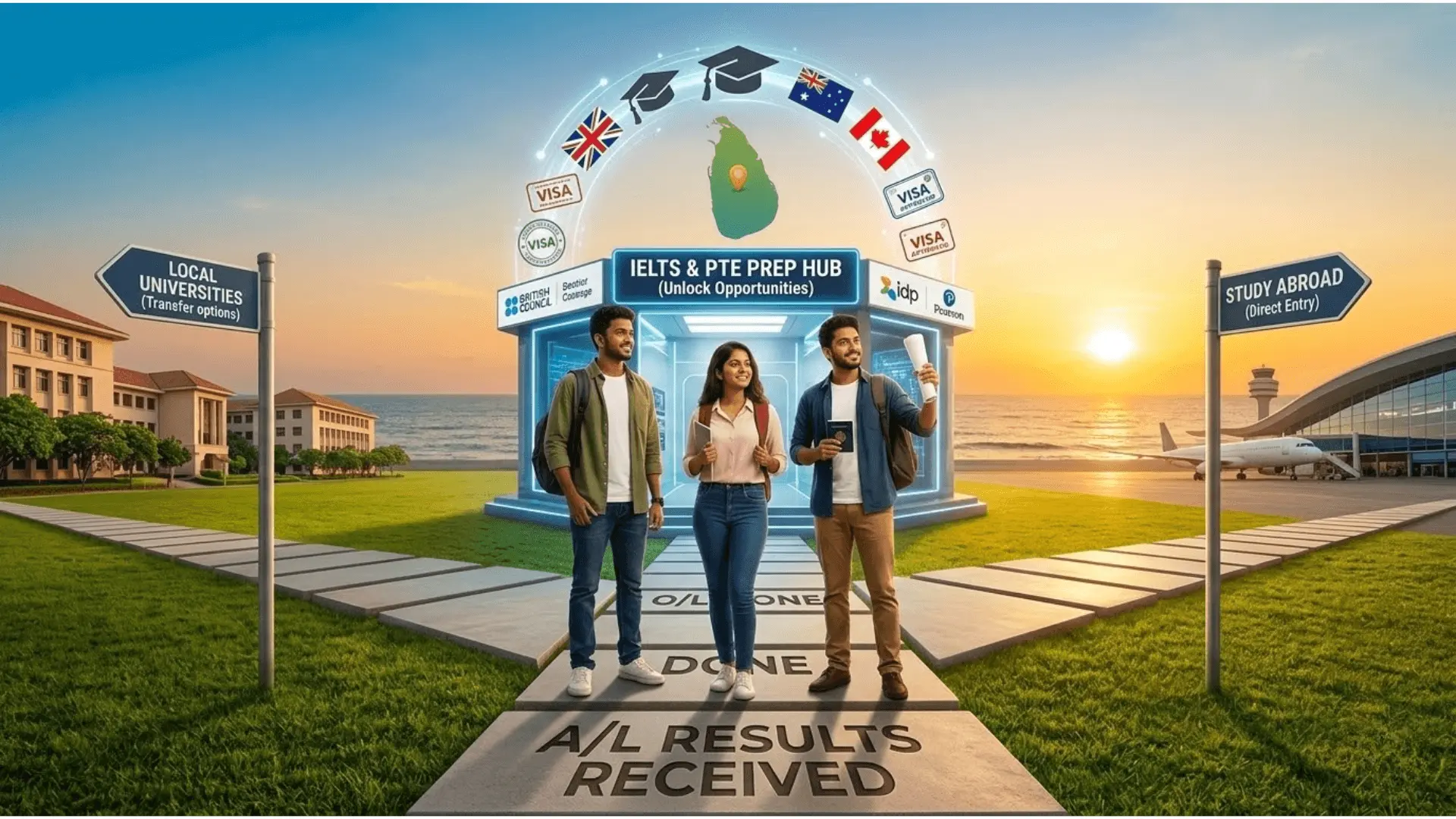
“You’ve finished your O/Ls or A/Ls — now every parent, relative, and neighbour has a different opinion on what you should do next. Sound familiar?”
At Zen Student Academy, we speak to hundreds of Sri Lankan students every year who are in exactly this moment. Results are out. Pressure is mounting. And there are more options than ever, which somehow makes choosing harder, not easier.
The good news: you don’t have to guess. Studying abroad is not a dream reserved for students with connections or unlimited money. It’s a structured path — and deciding what to do after O/L or A/L in Sri Lanka becomes much easier once you understand your options clearly.
In this guide, we’ll walk through the real pathways available to you, explain when IELTS or PTE becomes part of the picture, and help you start planning with clarity. One step at a time.
Understanding What to Do After O/L or A/L in Sri Lanka
Before we talk about study abroad, it’s worth understanding the two different stages and what they actually open up.
After O/L, students typically move into A/Ls — but that’s not the only option. Foundation programs, vocational pathways, diplomas, and even some international pre-university routes are available depending on your grades, goals, and budget.
After A/L, the options expand significantly. Local universities, private higher education institutions, foreign degree transfer programs, and direct international admissions are all on the table. Migration-linked education routes — where you study abroad as part of a longer-term PR or visa goal — are also increasingly popular among Sri Lankan families.
The honest truth: There is no single “right” path. The best next step depends on your Z-score or District Rank, your subject stream, your long-term career goal, your budget, your timeline, and the destination country you’re targeting. Study abroad is one serious option — not the only one.
Where does English come in? Most international institutions — whether for a foundation course, undergraduate degree, or visa application — require a recognised English proficiency score. That means IELTS or PTE often becomes one of the first practical milestones on any study abroad journey. We’ll break that down in detail shortly.
Main Pathways Sri Lankan Students Can Take After O/L or A/L
Here are the four most common routes we see students take at Zen Student Academy. Each has its own advantages depending on where you’re starting from.
Pathway 1 — Continue Locally First, Then Transfer Abroad
Complete your A/Ls, a diploma, or a foundation course in Sri Lanka, then use that credential to apply overseas. This is ideal if you want to save money, improve your English first, or take time to mature academically. Many students complete their local education, prepare for IELTS or PTE, and apply to Australia, the UK, or Canada. It’s a well-worn path — and a financially smart one.
Pathway 2 — Apply for a Foundation or Pre-University Programme Abroad
Best for students finishing O/Ls who want an accelerated international pathway. Some institutions abroad accept students at foundation level before direct degree entry — meaning you don’t need to wait until after A/Ls. English test scores (IELTS or PTE) are often still required, so early preparation makes a real difference here.
Pathway 3 — Apply Abroad After A/L for a Diploma or Bachelor's Degree
This is the most common route for A/L completers. With the right subject combination and a solid English test score, students can apply directly to undergraduate pathways in the UK, Australia, Canada, and beyond. IELTS or PTE typically becomes part of the admissions checklist at this stage. For example: a student finishes A/Ls, achieves their target IELTS band, and applies directly to a university program.
Pathway 4 — Improve Your English First Before Making the Big Move
Some students are academically ready but not yet language-ready. That’s completely normal — and fixable. Taking time to build real strength in speaking, writing, reading, and listening actually improves your admissions chances and your confidence once you get there. At Zen Student Academy, we start with a personalised placement assessment to map exactly where you are, then build a study plan around your goals and timeline.
Did you know? You may not need to wait until A/Ls.
Many Sri Lankan students — and their parents — assume international study only begins after A/Ls. That’s not always true. Several foundation programmes abroad accept students directly after O/Ls, opening up an accelerated path to a degree. If your O/L results are strong, this could save you 1–2 years. Always check entry requirements before ruling it out.
“I scored 75 in PTE in just 8 classes with Zen Student Academy. Their focused coaching helped me achieve my Skilled Migration goal to Australia.”
— Kethmi Nimaya, Lead Software Engineer at IFS · Skilled Migration to Australia Approved
IELTS vs PTE for Studying Abroad: Which One Should You Choose?
This is the question we get asked most often. Both tests are legitimate, globally recognised, and accepted by thousands of universities. But they work differently — and suit different students.
| Factor | IELTS | PTE |
| Test format | Human examiner for speaking; paper or computer options | Fully computer-based — speaking, writing, reading, listening |
| Speaking component | Face-to-face interview with an examiner | Recorded response to computer prompts |
| Results turnaround | 3–5 business days (computer); up to 13 days (paper) | Typically within 48 hours |
| Global acceptance | Over 12,500 institutions worldwide | 4,000+ universities and colleges globally |
| Best suited for | Students comfortable with face-to-face communication | Students who prefer typing and digital environments |
| Score type | Band score (0–9) | PTE score (10–90) |
| Visa acceptance | Widely accepted for study and migration | Accepted by multiple governments including Australia, UK, Canada |
⚠️ Always verify the latest visa-specific English requirements for your chosen country — they change. As of 2026, several countries including Australia and Canada are enforcing tighter per-skill score thresholds alongside stricter financial proof requirements for student visa applications. An English score alone is no longer sufficient — proof of funds, health insurance, and genuine student intent are increasingly scrutinised. Check the official immigration portal for your destination before registering for any test.
According to the IELTS official website, the Academic test is designed specifically for undergraduate and postgraduate study. According to Pearson’s PTE Academic page, the test delivers results in around 48 hours and is accepted by thousands of institutions globally.
From our experience coaching students at Zen Student Academy: PTE tends to suit students who are strong typists, comfortable with technology, and working against tight application deadlines. IELTS tends to suit students who communicate better in a live conversation and are targeting universities with a specific IELTS band requirement.
The bottom line: The best test depends on your destination, your target institution’s requirements, your personal strengths, and your timeline. We help every student work through this during their initial consultation.
How IELTS & PTE Impact Sri Lankan Students Planning to Study Abroad
An English proficiency test is not just an exam to tick off a list. Your score affects far more than the admission form.
University choices: A higher band score opens doors to more competitive institutions. A score that only just meets the minimum limits your options. Students who prepare seriously — rather than rushing — end up with more universities to choose from.
Visa readiness: For destinations like Australia, Canada, and the UK, English test results play a direct role in the Sri Lanka study visa process — especially as authorities tighten “Genuine Student” requirements in 2026. Many destination countries now assess per-skill thresholds, not just overall scores. A student who scores well overall but misses the minimum writing or speaking band can be rejected at the visa stage even with a valid university offer.
Scholarship competitiveness: Many scholarships use English test scores as part of the academic profile. A strong result strengthens your entire application.
Real confidence abroad: Students who prepare properly don’t just score better — they arrive better prepared for academic writing, seminars, and communicating in a new environment. That matters more than most people realise.
Benefits of Studying Abroad with the Right IELTS or PTE Strategy
More University Options & a Stronger Admission Profile
A competitive English score expands both the number and the quality of institutions you can realistically apply to. Many universities review applications holistically — and a solid IELTS band or PTE score reinforces the academic side of your profile, especially when your transcript is from a Sri Lankan school system that not all overseas admissions teams are familiar with.
Better Visa Readiness
For countries like Australia, Canada, and the UK, meeting the required English score per-section is often essential to visa approval — not just university entry.
Faster Decision-Making for Tight Deadlines
PTE’s 48-hour result turnaround is a real advantage when you’re working against an intake deadline or visa lodgement date.
Higher Confidence in Real Academic Environments
Proper preparation builds all four skills — speaking, reading, writing, listening — which are all genuinely used in degree-level study abroad.
Clearer Career Direction
Going through the process of choosing a test, setting a score target, and building a study plan often helps students get much clearer on their long-term goals too.
Step-by-Step Guide to Starting Your Study Abroad Journey After O/L or A/L
Here is the practical process we walk students through at Zen Student Academy, simplified into clear steps.
- Decide Your Goal First
Do you want to study abroad immediately, or in 1–2 years? Are you targeting a degree, diploma, or foundation course? Which country — and what’s your budget range? Getting clarity on these before anything else saves you months of confusion later.
- Check Whether You Need IELTS or PTE
Review the specific requirements of your target universities and the visa requirements of your destination country. Some institutions list both; others have a clear preference. Compare test formats, result timelines, and score targets before deciding.
- Assess Your Current English Level
Don’t guess. A proper diagnostic test shows you where you actually are — and prevents you from either wasting time on basics you already know or rushing past gaps that will cost you on exam day. At Zen Student Academy, every student starts with a personalised placement test.
- Build a Realistic Preparation Plan
Your plan should include weekly class hours, self-study time, scheduled mock tests, and an exam booking date that works backwards from your application deadline. Most of our students reach their target score within 2 to 10 weeks depending on starting level.
- Book the Exam Through Official Channels
For IELTS in Sri Lanka, book through official providers — British Council Sri Lanka or IDP Sri Lanka. For PTE, register via the official Pearson PTE portal. Never book through unofficial third parties. Check our IELTS exam booking guide in Sri Lanka for a step-by-step walkthrough.
- Prepare Your Application Timeline Early
Map out: your test date → score release date → application deadline → visa lodgement window → scholarship deadlines. Working backwards from these dates prevents last-minute panic and missed opportunities.
Common Mistakes Sri Lankan Students Should Avoid After O/L or A/L
- Choosing a path based on pressure, not goals.
Parents, friends, and social media trends are not a study plan. What works for your classmate may not fit your academic profile, career goal, or budget.
- Preparing for the wrong English test.
Some students pick IELTS or PTE without checking what their specific target institutions actually accept. Always verify before you invest months of preparation.
- Waiting too long to start English preparation.
Students who delay often find themselves cramming with no time for proper mock practice. An earlier start means a less stressful experience and a better score.
- Ignoring intake and visa timelines.
Missing an intake by a few weeks can delay your entire plan by 6 months or more. Timeline planning is not optional — it’s essential.
- Assuming study abroad only starts after A/L.
Some O/L completers have valid international pathways via foundation programmes. Don’t eliminate options before you’ve explored them.
- Treating the exam as the only thing that matters.
The English score is one piece of a larger puzzle that also includes academic transcripts, personal statements, financial evidence, and visa documentation. Plan the full picture.
Conclusion
Finishing your O/Ls or A/Ls is a real milestone — but it’s also just the beginning of a much bigger set of decisions. The good news is that Sri Lankan students today have more credible pathways to international education than ever before.
Whether you’re just beginning to explore what to do after O/L or A/L in Sri Lanka, trying to decide between IELTS and PTE, or ready to start preparing right now — the most important thing is to start with a clear plan rather than guessing your way forward.
At Zen Student Academy, we’ve helped hundreds of students take exactly this journey: from a post-exam conversation about options, through personalised English test preparation, to achieving their target scores and securing places at institutions abroad. We’re an official IDP partner in Sri Lanka, and our courses run flexibly for 2 to 10 weeks depending on your level and deadline.
The next step doesn’t have to feel confusing when you have the right guidance. Join our IELTS course in Sri Lanka, explore our PTE coaching programme, or start with a free consultation.
FAQs About What to Do After O/L or A/L in Sri Lanka
Can I study abroad after O/L in Sri Lanka?
Yes — in some cases, students can begin international pathways after O/L through foundation or pre-university programmes. Eligibility depends on the country, the institution, your subject results, and English requirements. Don’t assume you must wait until A/Ls are complete. Check progression options carefully and speak to an adviser about what’s available at your level.
Is IELTS or PTE better for Sri Lankan students who want to study abroad?
There is no universal “better” test. IELTS may suit students who are comfortable communicating with a live examiner and targeting institutions with a specific IELTS requirement. PTE may suit students who prefer a fully computer-based format and need results quickly. The best choice depends on your destination country, target university, personal strengths, and application timeline. Both are strongly recognised for academic and visa purposes.
What is the first step to studying abroad after A/L?
Start by identifying your target course, country, and realistic timeline. Then check the admission requirements for that institution — including whether they require IELTS or PTE and what minimum score is expected. After that, assess your current English level honestly and build a preparation plan. Early planning significantly improves your chances of hitting both the score and the application deadline.
How long does it take to prepare for IELTS or PTE?
It depends on your current English level and target score. Students starting from a lower level may need a longer, more structured programme. Students already near their target may improve significantly in a focused 2–4 week sprint with mock tests and feedback. At Zen Student Academy, our course durations typically range from 2 to 10 weeks, tailored to where you start and what you need to achieve.
Do universities accept both IELTS and PTE?
Many do, but not all — and you should never assume. IELTS reports acceptance by over 12,500 institutions globally, while Pearson states PTE Academic is accepted by 4,000 universities and colleges worldwide. Always check the specific requirements of every institution on your shortlist before deciding which test to sit. Don’t choose based on assumptions.
Can Zen Student Academy help me choose between IELTS and PTE?
Yes. Our free consultation is specifically designed for students at this exact decision point. We assess your current English level, discuss your target destination and institutions, review your timeline, and recommend the most suitable test and preparation strategy. There’s no pressure and no guesswork. Book your free study abroad consultation here.

Shiney
Shiney Umaya is an IELTS, PTE, CELPIP and Business English expert with over 10 years of coaching experience. As the founder of Zen Student Academy and a Cambridge & University of London certified teacher, she is dedicated to helping students achieve Band 7+ scores and unlock their global potential.